How a single click turned into a multistage compromise
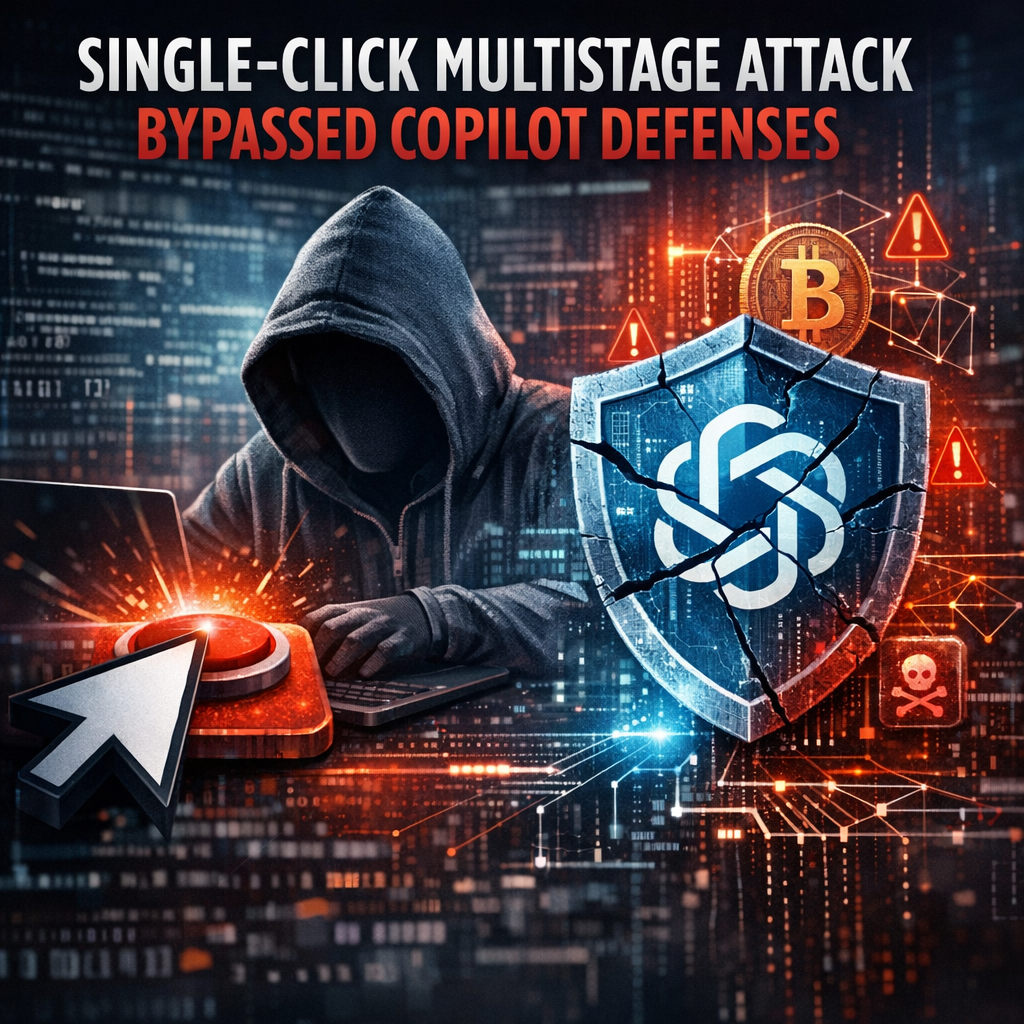
Security researchers have disclosed a demonstration in which a single user interaction — a click inside a Copilot-enabled interface — triggered a covert, multistage attack chain that moved beyond the initial machine learning assistant and into enterprise systems. The demonstration targeted Microsoft Copilot integrations and showed how linked connectors, webhooks and tokens can be abused to escalate access, exfiltrate secrets and mount lateral movement within an organization.
The disclosure, which was circulated to vendors and published alongside technical artifacts, did not describe a wide-scale breach in the wild but illustrated a realistic attack path against modern assistant platforms that are woven into business workflows.
Attack mechanics and technical context
At the core of the demonstration are a set of well-known attack primitives: prompt injection, credential abuse, and chained service calls. Copilot-style assistants routinely access context from emails, documents and third-party services via connectors and OAuth tokens. In the demonstrated sequence, a seemingly innocuous click opened content that contained crafted payloads for the assistant and for downstream services. That content triggered a sequence of automated requests — including webhook callbacks and API calls — that leveraged previously granted tokens and permissions.
Researchers described the chain as multistage because each step relied on outcomes from the prior one: the assistant would ingest and act on content, invoke an external service with the caller’s credentials, and then use the response to craft additional instructions that coaxed other services into revealing data or escalating privileges. Techniques referenced in the disclosure included prompt injection (maliciously crafted text interpreted by the model), SSRF-like redirections via connectors, and token replay/exfiltration where access tokens were handed off to attacker-controlled endpoints.
Why Copilot-style integrations are attractive targets
Copilot and similar assistants are useful precisely because they can interact with many enterprise systems on behalf of users. That convenience — OAuth grants to calendars, mailboxes, file stores and CI/CD systems — increases the attack surface. The assistant effectively becomes an orchestrator with user-level access.
Industry experts say the risk is not limited to any single vendor. “Any assistant that aggregates context and has permissions to act on behalf of a user can be made to perform actions attackers want, if the content it ingests is untrusted,” an independent security researcher who reviewed the disclosure told this publication. “This is about the composition of services and permissions as much as it is about the model itself.”
Implications for enterprises and supply chains
Even though the public disclosure was described as a proof-of-concept, the implications are significant. Enterprises that deploy Copilot across Microsoft 365, GitHub or other environments rely on tokens, connectors and automation flows that can reach deep into networks and CI/CD pipelines. A successful multistage attack could lead to credential theft, exposure of intellectual property, tampering with build systems or seeding of malicious code into repositories.
Security teams must therefore think beyond the model and toward the surrounding integration fabric: strict token lifetimes, granular scopes, allowlisting of endpoints, input sanitization, and robust observability for assistant-initiated actions. Endpoint and identity defenders should consider conditional access policies that restrict what automated agents can do, and monitor for atypical sequences of API calls originating from assistant integrations.
Expert perspectives and recommended mitigations
“This disclosure is a reminder that convenience can introduce systemic risk,” said a former security architect now working in the enterprise SaaS space. “Mitigations need to be layered: limit what connectors can access, apply the principle of least privilege to tokens, and treat model inputs as untrusted data sources.”
Researchers recommended several practical controls: enforce per-connector scopes, require interactive consent for high-risk operations, implement telemetry that ties assistant actions back to user sessions, and use content sanitization or prompt filters to reduce prompt-injection vectors. Software supply-chain controls, such as signing, verification and immutable build artifacts, can also reduce the impact if an assistant is used to trick CI/CD tooling.
Conclusion: watch the orchestration, not just the model
The reported single-click, multistage demonstration against Copilot-style integrations highlights a central lesson for security teams: the model is only one piece of a broader runtime that includes connectors, tokens and procedural logic. As organizations accelerate adoption of AI assistants, protecting the orchestration layer, tightening identity controls and increasing observability will be critical to limiting the blast radius of similar attacks.
For now, vendors and enterprises are digesting the disclosure and assessing controls. Administrators should inventory assistant integrations, reassess token scopes and enable richer logging to detect suspicious assistant-driven workflows. The attack demonstrated how quickly convenience can become a vector — but it also showed that a combination of engineering controls and security hygiene can substantially reduce risk.
About the Author