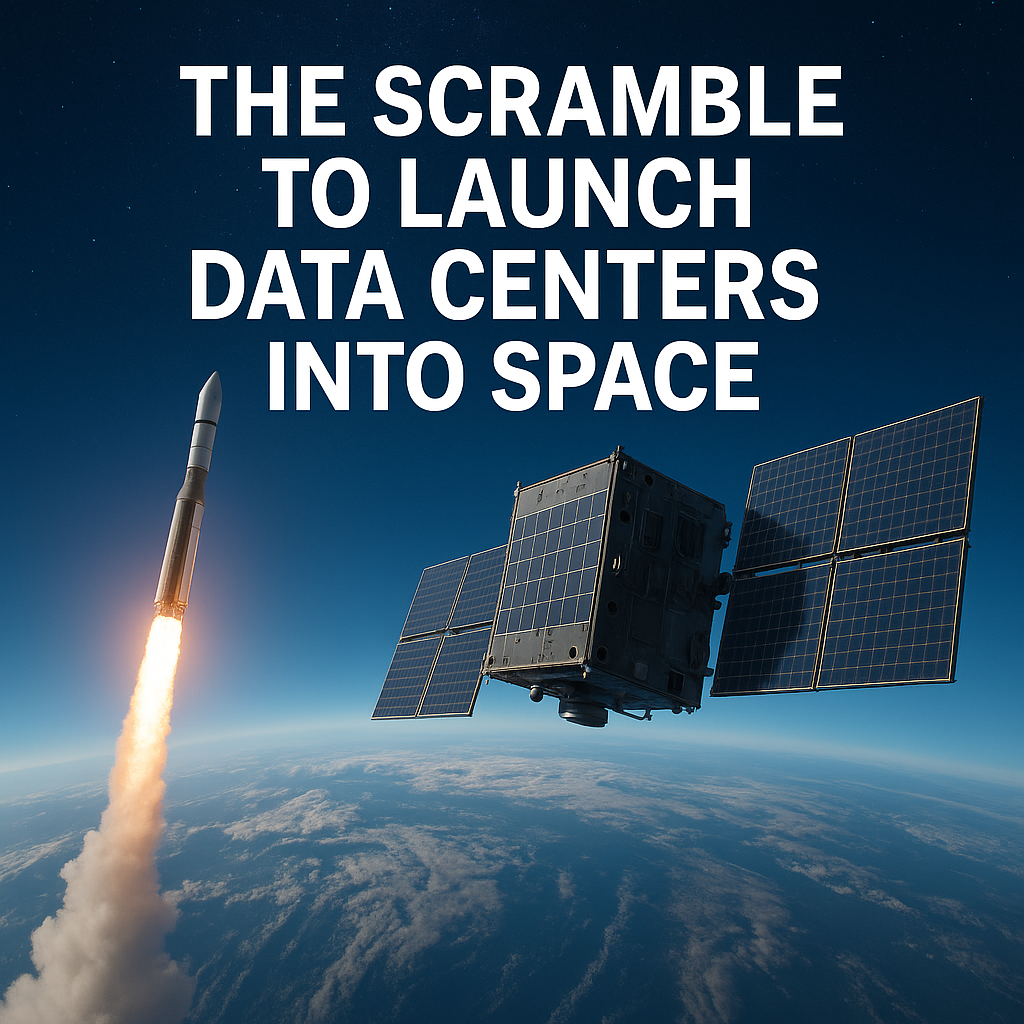
Orbital servers: the race begins
Corporations and startups are accelerating plans to put data centers in space. From prototype experiments on the International Space Station to proposals for encrypted orbital storage rings, the push has intensified over the past decade as cheaper launches, booming satellite constellations and edge computing demand collide. Key milestones include Hewlett Packard Enterprise’s Spaceborne Computer experiment on the ISS in 2017 and a wave of commercial proposals such as Cloud Constellation’s SpaceBelt concept that first surfaced in the mid-2010s.
Why companies are betting on data centers in space
The motivation is a mix of technical opportunity and market differentiation. Operators argue that in-orbit compute can reduce latency for inter-satellite processing, provide sovereign or highly resilient storage, and enable new classes of applications for remote sensing, defense and high-frequency trading between ground stations and satellites. The proliferation of small satellites and low Earth orbit (LEO) constellations has created a mesh that could, in theory, host distributed compute workloads above the atmosphere.
Economic dynamics are shifting, too. Reusable rockets such as SpaceX’s Falcon 9 have driven down launch prices since the 2010s; a Falcon 9 manifest price commonly cited in industry analyses is roughly $62 million and the vehicle can loft on the order of tens of thousands of kilograms to LEO in certain configurations, improving the per-kilogram math for heavier payloads. Meanwhile, cloud providers have expanded space-focused services: Amazon Web Services launched AWS Ground Station in 2018 to manage satellite downlinks, and Microsoft has promoted Azure Orbital as part of broader cloud-and-space partnerships. Those services indicate how major cloud vendors see space as an extension of the edge and hybrid cloud.
Technical challenges: radiation, cooling and reliability
Designing servers for space is not a simple transplant of terrestrial racks. Electronics in orbit face high radiation doses that cause bit flips and component degradation, so hardware must incorporate radiation-tolerant designs, error-correcting memory and fault-tolerant software. Thermal management also becomes a complex engineering problem: in vacuum, waste heat must be radiated into space via panels, rather than convected away by air. The HPE Spaceborne Computer experiment used commercial-off-the-shelf components with software to handle faults and demonstrated that COTS hardware can operate in orbit for limited periods, but long-duration, commercial-class orbital data centers demand additional hardening.
Regulatory, debris and cost constraints
Orbital infrastructure triggers regulatory reviews across spectrum allocation, licensing and liability. National regulators like the US Federal Communications Commission handle spectrum and launch licensing, while international frameworks including the Outer Space Treaty and ITU procedures touch on frequency coordination and orbital slots. Operators must also contend with orbital debris risk and end-of-life disposal plans, adding both engineering and policy complexity. Taken together, these hurdles increase cost and slow timelines compared with terrestrial data centers.
Expert perspectives
Industry analysts see a split between near-term niche use cases and longer-term commercial viability. Engineers point to compelling use cases such as in-orbit data reduction for Earth-observation constellations, where preprocessing images in space could dramatically cut down costly downlink bandwidth. Infrastructure investors, however, note that the cost per terabyte will remain high until launch costs fall further and radiation-hardened server economies of scale emerge.
Security specialists highlight one of the strongest selling points: sovereign or highly resilient storage. Cloud Constellation’s SpaceBelt, for example, has marketed an orbital storage ring intended to give customers an encrypted, physically isolated path for sensitive data, though the business model has yet to see broad commercial adoption.
Implications for cloud, defense and edge computing
If orbital data centers become practical, they could reshape certain segments of cloud infrastructure. For enterprise users, a niche market may emerge for high-assurance, geographically independent storage and for latency-sensitive satellite-to-satellite processing. Defense agencies and government contractors are likely early customers, given the value of resilient, contested-domain communications. For the broader cloud market, however, Earth-based hyperscale data centers will remain far more cost-effective for general workloads.
What comes next
Expect continued experimentation over the next few years. Companies will refine thermal control, radiation mitigation and fault-tolerant software, while regulatory bodies and insurers begin to weigh the liabilities of commercial orbital infrastructure. The near-term winners will likely be specialized service providers and defense-focused customers, with broader commercial adoption hinging on further declines in launch costs and clearer regulatory pathways.
Related topics worth following include edge computing strategies, satellite internet constellations such as Starlink and Project Kuiper, launch economics, orbital debris mitigation and cloud provider space services like AWS Ground Station and Azure Orbital. As orbital activity accelerates, the question is not whether there will be servers in space, but which workloads will justify the journey.
About the Author