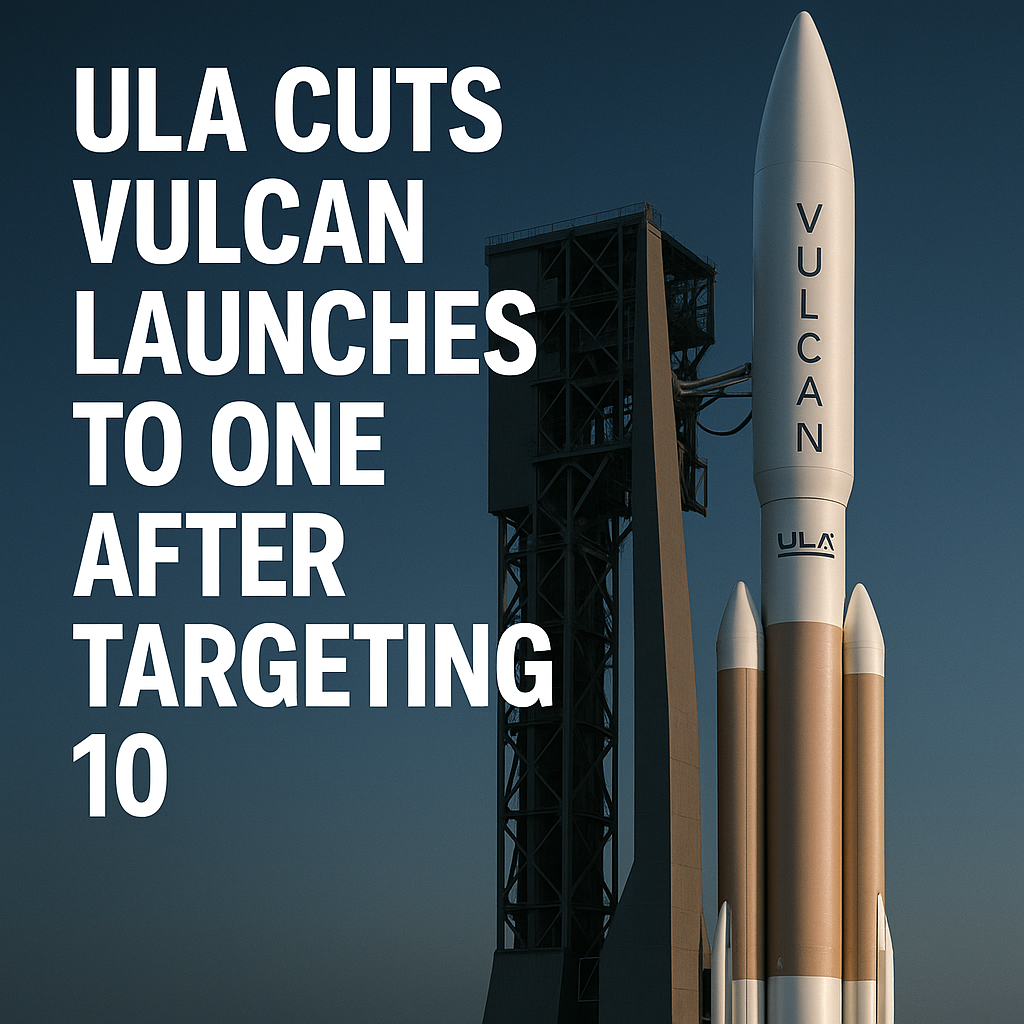
ULA scales back Vulcan cadence: from up to 10 to a single flight
United Launch Alliance (ULA), the Colorado-based launch provider behind Atlas V and Delta IV, has sharply revised its Vulcan Centaur schedule. After earlier guidance that the company could fly as many as 10 Vulcan rockets this year, ULA now expects the vehicle to fly just once during the current calendar year, according to company communications to customers and confirmed by industry sources. The change underscores ongoing supply-chain and certification pressures around the Blue Origin BE-4 engine and slows ULA’s transition away from legacy hardware.
Background: Vulcan, BE-4 and ULA’s fleet transition
Vulcan Centaur is ULA’s next‑generation launch system designed to replace the Atlas V and Delta IV families. The rocket uses Blue Origin’s methane-fueled BE-4 engines on its first stage and a modernized Centaur upper stage to meet a range of commercial, civil and national security missions. ULA has long positioned Vulcan as its workhorse for U.S. Space Force launches, NASA payloads and commercial rideshares, intending to ramp production and launch cadence over several years.
But the Vulcan program has been constrained by availability and certification work for Blue Origin’s BE-4. The engine—designed to replace the Russian RD‑180 that powered Atlas V first stages—has faced technical and throughput challenges during qualification and manufacture. Those constraints have had knock-on effects across ULA’s mission manifest and its ability to meet earlier optimistic cadence targets.
What changed and why it matters
Shifting from an aspirational plan of up to 10 launches to a single flight is a material retreat. A slower Vulcan ramp delays ULA’s planned retirement of Atlas V and Delta IV Heavy vehicles and potentially forces customers — including the U.S. Space Force and NASA — to keep buying time on legacy rockets or seek alternative providers. It also affects ULA’s commercial business and its supplier base in the United States, as a lower manifest translates into fewer contract awards for ground support, integration and logistics work.
From a market perspective, the move gives competitors room. SpaceX’s Falcon 9 and Falcon Heavy continue to dominate high-frequency launches with hundreds of flights in recent years and established reuse economics. A constrained Vulcan cadence further cements SpaceX’s ability to attract both commercial and government payloads that prize guaranteed schedules and lower cost per kilogram to orbit.
Program and procurement implications
For U.S. national security customers, cadence uncertainty matters. Launch support contracts and mission assurance plans are tightly choreographed; delays incur cost, schedule and risk implications across satellite programs. ULA has historically been a lead contractor for classified and high-value payloads thanks to decades of reliability—more than a hundred successful launches between Atlas, Delta and earlier platforms—but continuity in that role depends on delivering a stable, predictable launcher supply.
Expert perspectives
Industry analysts point to BE-4 production limits and a cautious approach to flight rate as the primary drivers. Analysts say Blue Origin’s BE-4 throughput and certification timeline are the gating factors for ULA’s ability to sustain a multi-launch cadence. A lower initial flight rate also reflects ULA’s conservative mission assurance posture: the company typically prioritizes a flawless first flights sequence over rapid quantity.
“A conservative ramp is not surprising for a brand‑new vehicle with a new engine partner,” said one industry consultant familiar with launch operations. “But market dynamics mean ULA will pay a price if it can’t lock in more flights this year—customers will look elsewhere for capacity and price certainty.”
What to watch next
Key indicators to monitor are BE-4 engine deliveries from Blue Origin, any updated schedules ULA provides for additional Vulcan flights, and how customers rearrange manifests. ULA’s ability to transition missions off Atlas V — which uses the Russian RD‑180 engine lineage — depends squarely on restoring a steady BE-4 supply and completing any outstanding vehicle and payload certifications.
Internally, ULA will be balancing workforce planning and factory throughput at its Decatur, Alabama, and Centennial, Colorado facilities. Externally, the U.S. Space Force and other government customers may need contingency planning to avoid capability gaps.
Conclusion: a cautious ramp with broad implications
ULA’s retreat from an ambitious Vulcan launch count to a single flight this year is a reminder that building a new domestic launch vehicle at scale remains difficult. The decision highlights the centrality of propulsion supply chains—chiefly Blue Origin’s BE-4—to national launch posture and commercial competitiveness. For customers, the slowdown raises procurement and scheduling questions; for competitors, it’s an opportunity. The coming months will show whether ULA can accelerate deliveries and restore momentum for Vulcan, or whether the launch market will consolidate further around incumbents with higher cadence and lower unit costs.
Internal linking opportunities: Atlas V retirement, Blue Origin BE-4 status, SpaceX Falcon 9 cadence, U.S. Space Force launch procurement.
About the Author