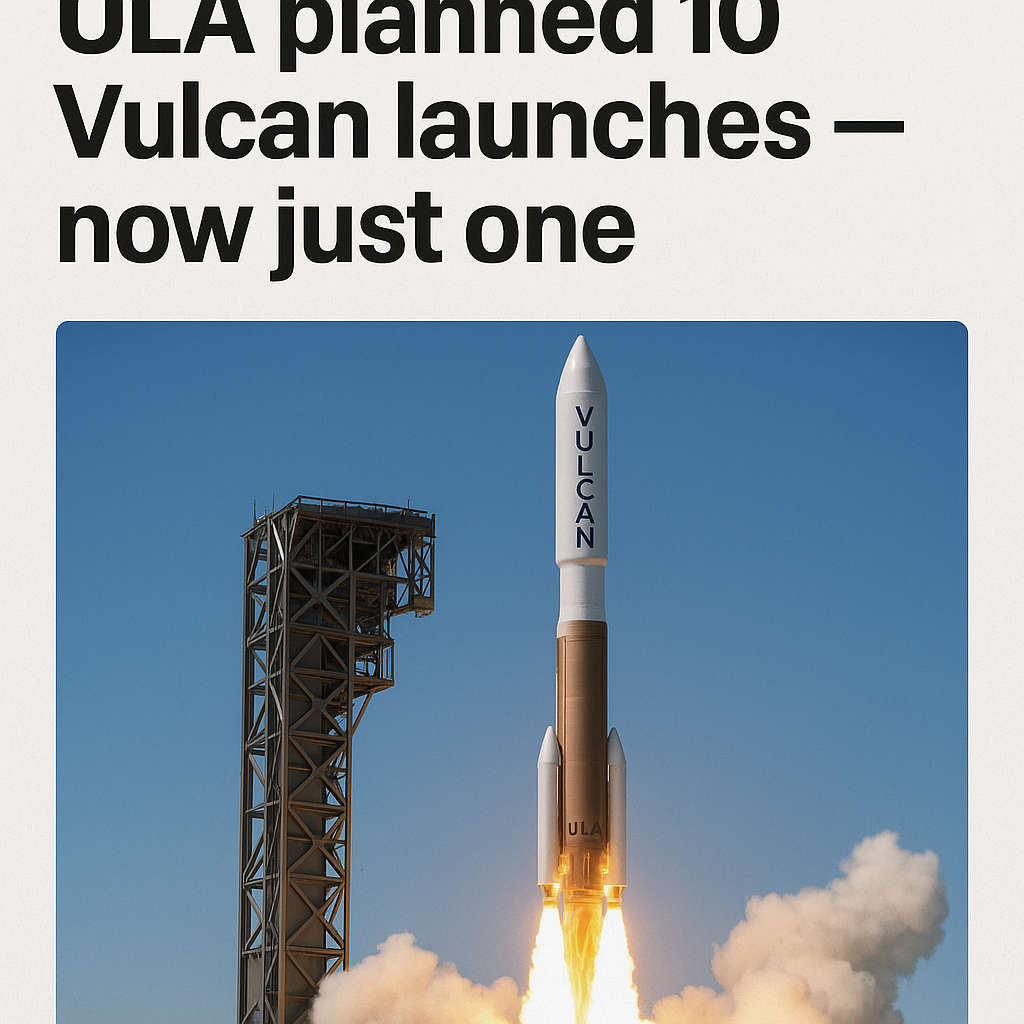
ULA scales back Vulcan cadence: from ambition to a single flight
United Launch Alliance (ULA) had been publicly aiming to field an aggressive cadence for its new Vulcan Centaur rocket — as many as 10 launches this year — but company and government manifests now show the vehicle will fly just once. The dramatic pullback underscores lingering production bottlenecks, supplier delays and testing challenges that have dogged the BE-4 engines and Centaur upper-stage work, and it has immediate implications for customers, the U.S. Department of Defense (DoD) and the broader commercial launch market.
Background: the Vulcan program and its strategic role
Vulcan Centaur is ULA’s next-generation, partially reusable launch vehicle intended to replace Atlas V and Delta IV. Designed around twin BE-4 engines from Blue Origin on the first stage and the Centaur V upper stage, Vulcan is central to ULA’s long-term plan to compete on cost and cadence with SpaceX’s Falcon 9 and to meet U.S. national-security launch needs under the National Security Space Launch (NSSL) program.
From the program’s earliest public statements, ULA positioned Vulcan as a workhorse for government and commercial missions — capable of flying frequently and carrying a wide range of payloads, from classified DoD satellites to NASA science missions. That ambition is now colliding with reality: only one Vulcan flight is on the manifest for this year.
Why the schedule collapsed: engines, supply chain and testing
The downshift to a single Vulcan flight is the result of multiple technical and industrial factors. Blue Origin’s BE-4, the methane-fueled engine chosen for Vulcan, has experienced a protracted development and qualification campaign. Meanwhile, the Centaur V upper stage — a heavier, more powerful evolution of the long-serving Centaur family — has required additional testing and qualification to meet mission assurance requirements for high-value national security payloads.
Supply-chain issues that have affected aerospace broadly over the last several years — parts lead times, logistics, and workforce constraints — have compounded schedule pressure. For ULA, which has historically emphasized near-zero launch risk and tight integration with government customers, slipping hardware and schedule certainty can cascade into conservative decisions that reduce planned flight rates.
Manifest reshuffling and customer consequences
Customers who had expected more frequent Vulcan launches now face tighter launch slots and longer waits. Some payloads may be redistributed to Atlas V or other providers, and commercial satellite operators will watch whether ULA offers attractive pricing and schedule certainty to retain business against incumbents such as SpaceX and emerging competitors. For the DoD, any shortfall in domestic launch capacity raises questions about redundancy and assured access to space — particularly for classified and time-sensitive missions.
Industry perspective and expert analysis
Industry analysts say the one-flight outcome signals a more cautious near-term approach for ULA as it finishes hardware verification and scales production. A veteran launch-industry observer noted that achieving a reliable, repeatable cadence requires not only mature hardware but also a robust supplier base and streamlined integration processes — areas where Vulcan still needs to prove itself.
Competitive dynamics matter. SpaceX continues to fly Falcon 9 at high cadence and has lowered cost expectations across the market, pressuring traditional integrators to show value beyond raw price. If ULA cannot reliably ramp Vulcan to the touted double-digit annual flights, government planners may spread future tasking across a more diverse set of providers or accelerate contracts that favor rapid, high-cadence commercial launchers.
Implications for U.S. national security and commercial markets
For the U.S. national-security launch portfolio, a constrained Vulcan cadence could shift risk onto remaining vehicles and providers. The NSSL framework aims for resilience by engaging multiple vendors; a weaker-than-expected ULA output tightens that margin. Commercially, satellite operators seeking timely rides may prefer providers with demonstrated frequent flights and flexible manifest options.
Conclusion: what’s next for Vulcan and ULA
ULA’s move from a target of up to 10 Vulcan launches to a single flight this year is a setback, but not necessarily a fatal one. The company’s historical strength in mission assurance and its deep relationships with DoD and NASA give it runway to fix supply-chain issues, complete testing campaigns and ramp production in subsequent years. The coming 12–24 months will be critical: successful, routine Vulcan flights could restore confidence and rebalance market expectations; continued delays, however, will accelerate customers’ diversification strategies and intensify competitive pressure from SpaceX and others.
Related topics: SpaceX Falcon 9 cadence, Blue Origin BE-4 engine, National Security Space Launch (NSSL), Atlas V retirement, satellite launch market competition.
About the Author