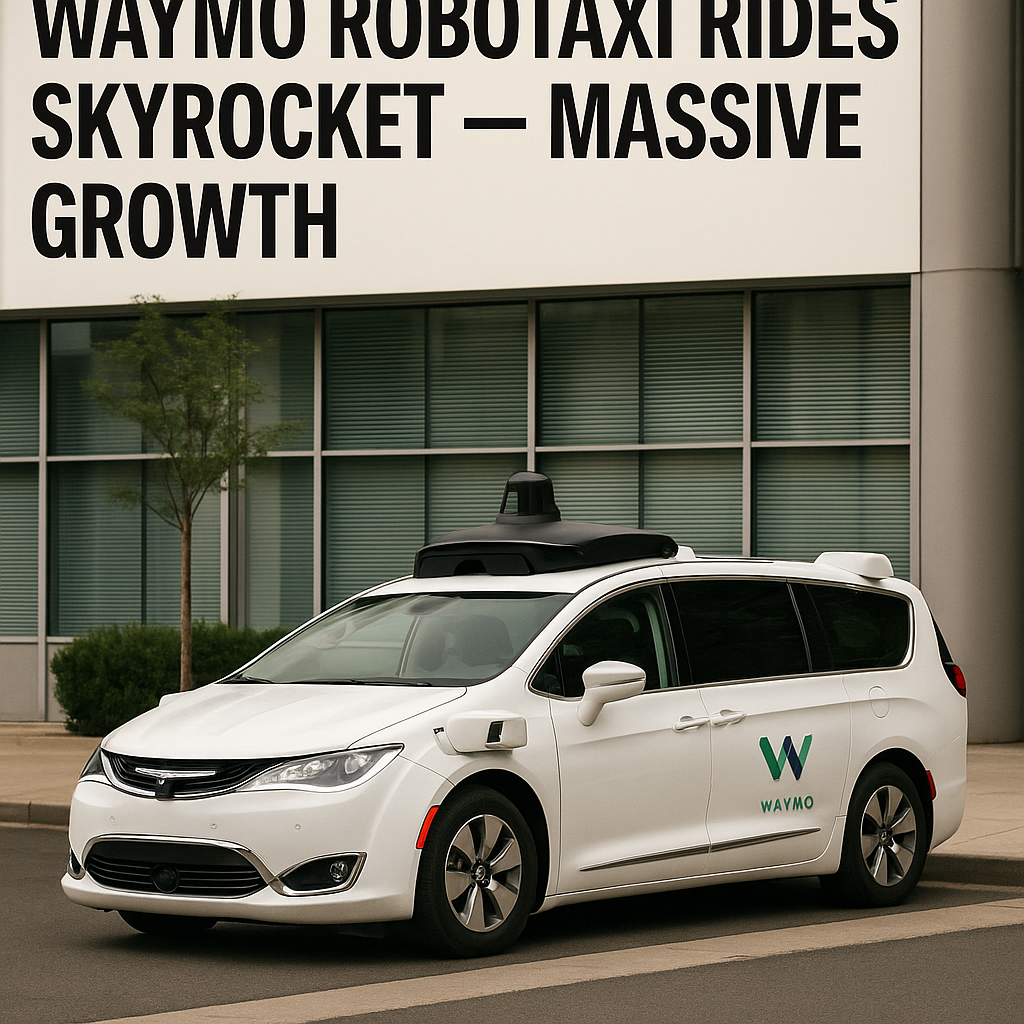
Investor letter: Ridership surges for Waymo’s robotaxis
An investor letter from Waymo released this week reveals that robotaxi ridership has surged dramatically as the Alphabet-owned autonomous driving unit expands commercial operations. The company said demand for Waymo One — its public robotaxi service — accelerated in recent quarters, with the letter calling out “triple‑digit year‑over‑year growth” and a steep increase in monthly active riders across Phoenix and San Francisco.
Background: Waymo’s commercialization and markets
Waymo, a subsidiary of Alphabet (GOOGL), has been operating public robotaxi services since the Waymo One pilot in the Phoenix metro area launched in late 2018. The company later introduced driverless and limited commercial service in parts of San Francisco and has been testing expanded coverage and rider pricing strategies. Waymo’s technology stack — the Waymo Driver — integrates LiDAR, cameras, radar and custom perception and planning software designed for driverless operation at scale.
The investor letter, addressed to shareholders and partners, frames the recent ridership jump as evidence that Waymo is moving beyond pilot mode and toward sustainable commercial scale. It cites network densification, increased vehicle utilization, and smoother rider onboarding as key operational drivers.
What the data means
While the letter did not publish a full earnings-style data sheet, the narrative points to several concrete operational shifts: tighter dispatching algorithms, higher vehicle uptime in urban cores, and expanded availability windows in some markets. Those changes typically translate into better utilization rates for fleets — a core metric for robotaxi economics — because each vehicle can earn more rides per operational hour.
For Waymo, improving utilization matters because unit economics for autonomous vehicles remain tightly linked to per‑vehicle throughput, maintenance costs, and software improvements. Higher ridership also gives Waymo richer telemetry to refine maps and machine‑learning models, accelerating improvements in route planning and safety validation.
Competitive context and industry impact
Waymo’s growth will be watched closely by competitors and regulators. Major rivals in the space include Cruise (backed by GM), Motional (a Hyundai–Aptiv joint venture), and Tesla’s Autonomy ambitions. Each player is pursuing different go‑to‑market strategies — from fleet deployment to partnerships with rental and logistics companies — but rising consumer adoption of robotaxis strengthens the broader business case for AV commercialization.
Expert perspectives
Industry analysts said the investor letter underscored an inflection point for robotaxi services. “When an operator moves from localized pilots to sustained, repeatable ridership growth, you begin to see the levered economics that can justify scaling,” said Sarah Lewis, an autonomous mobility analyst at a transportation consultancy. “Key will be how quickly companies can replicate high‑utilization pockets across multiple cities without ballooning costs.”
Regulatory and public‑policy experts noted a separate implication: more rides mean more real‑world exposure for driverless systems, which can accelerate both positive safety data collection and regulatory scrutiny. “Scaling robotaxi operations brings operational and public relations challenges as much as it does financial upside,” said Mark Chen, a transportation policy fellow at a university think tank.
Risks and open questions
Despite the upbeat tone, the investor letter also acknowledged challenges. Waymo highlighted the need to keep margins under control as fleet sizes increase, address seasonal demand swings, and navigate varying municipal rules on driverless vehicles. There is also the ongoing question of pricing: whether robotaxis can win riders from low-cost ride-hailing incumbents such as Uber and Lyft without heavy subsidy in the early stages.
Conclusion: What’s next for Waymo and the robotaxi market
The investor letter positions Waymo as one of the first autonomous driving companies to show a clear path toward scaling consumer rides. If the growth continues, it could accelerate partnerships with automakers and municipal fleets, push competitors to increase investment, and prompt closer regulatory engagement. For now, Waymo’s reported ridership surge is an inflection signal — proof that a market for driverless mobility exists, even as companies grapple with how to turn demand into durable profit.
About the Author