What’s happening: YouTube brings AI likenesses to Shorts
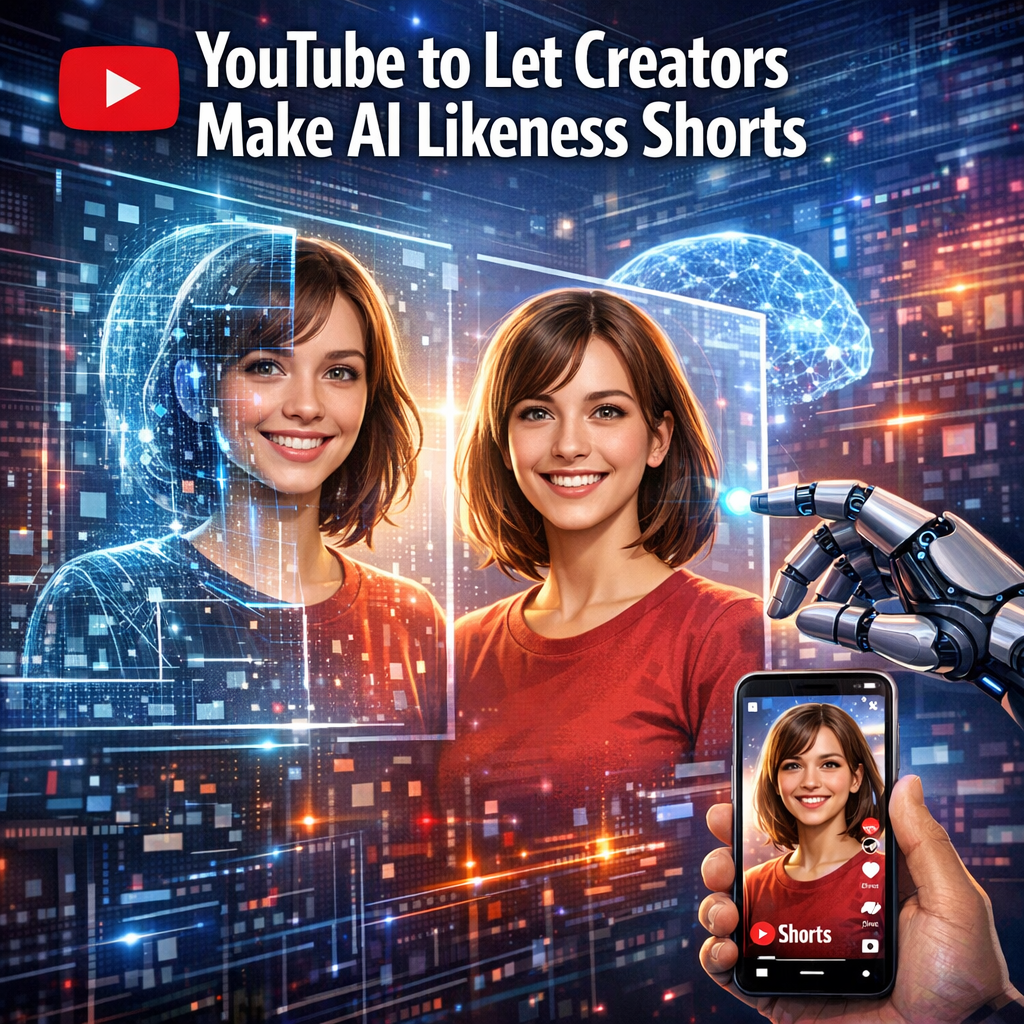
YouTube, the short-form video platform owned by Alphabet’s Google, has announced a forthcoming feature that will let creators generate YouTube Shorts using AI-driven likenesses of themselves. The move extends the platform’s growing suite of generative tools into Shorts, allowing creators to produce videos without always recording new footage in front of a camera. YouTube says the capability is intended to help creators scale output, experiment with formats and reach audiences with faster turnaround.
How the feature will work and where it fits
According to YouTube’s product roadmap and public statements, creators will be able to train or select an AI model that reproduces their image and voice characteristics to varying degrees, then use that model inside the Shorts creation flow. The generated clips will be optimized for vertical, short-form consumption. While YouTube has not published full technical details, industry observers expect the feature to combine avatar-generation, text-to-video or text-to-speech components, and safety controls to limit misuse.
Integration with existing YouTube systems
The new tool will sit alongside YouTube’s existing Shorts editor and other creator features. Platform-level safeguards are likely to lean on familiar systems such as Content ID, policy enforcement workflows, and user reporting. YouTube’s prior investments in automated moderation, machine learning classifiers and metadata tagging will be critical to scaling review of synthetic content at Shorts volume.
Background: why now for synthetic avatars
Big tech platforms have accelerated their rollout of generative AI since 2022. For creators, synthetic avatars and AI likenesses promise time savings, the ability to produce content in multiple languages, and new storytelling possibilities. For platforms, such features can drive engagement and keep users within an ecosystem that now rewards rapid, frequent publishing. Shorts, which competes directly with TikTok and reels-style offerings, is a natural target for AI-driven productivity tools.
Risks, rights and moderation challenges
Introducing creator-controlled AI likenesses raises a host of legal and policy issues. Unauthorized impersonation, voice cloning, defamation and age-related concerns are among the top risks cited by privacy and safety experts. Copyright and publicity-rights questions will also surface when a creator’s likeness is repurposed into derivative works or when multiple contributors’ images or voices are combined.
Platforms have several levers to manage risk: explicit consent flows, provenance metadata that tags content as synthetic, visible watermarking, and limits on how closely an AI model can recreate a real person. YouTube’s enforcement teams will also need to refine takedown processes and consider whether new account verification or opt-in regimes are required for likeness creation and distribution.
Industry and creator perspectives
Creators see upside and downside. On the positive side, AI likeness tools can let solo creators produce multi-character sketches, localize content into other languages, or maintain posting cadence while traveling. For smaller teams, the feature could be a force multiplier.
At the same time, creators and rights holders worry about brand dilution and the potential for low-quality synthetic content to erode trust in original work. Analysts note that monetization models will be consequential: how YouTube treats ad revenue, sponsorship disclosures and creator payments for AI-generated Shorts will shape adoption.
Expert insights
Privacy advocates have urged platforms to mandate clear disclosures when content is synthetic and to provide easy mechanisms for individuals to contest unauthorized replicas of their likeness. Moderation specialists emphasize that automated detection must be paired with rapid human review for edge cases. Economists and creator-economy researchers predict a short-term boost in content volume, followed by a market correction as platforms and audiences adapt to synthetic norms.
Conclusion: what creators and viewers should watch for
YouTube’s plan to allow creators to make Shorts using their own AI likeness is a consequential step in the commercialization of synthetic media on mainstream platforms. For creators, it offers new creative and efficiency gains; for viewers, it raises questions about authenticity. Regulators, rights holders and platform engineers will all play a role in shaping how safe, transparent and economically fair this technology becomes. In the coming months, watch for YouTube to publish technical guidance, safety guardrails and monetization rules that will determine whether AI likenesses become a routine part of the Shorts ecosystem or a contested flashpoint in platform governance.
About the Author